The easiest way to make a data blog look impressive is to claim a large global market and a high CAGR. The harder and more useful way is to show numbers a reader can check, explain what they measure and state their limits. The five figures below are public U.S. reference points for exterior lighting; they are not a forecast for every country.
How widely has LED reached outdoor lighting?
In the U.S. 2018 analysis cited by DOE, outdoor lighting had 51.4% LED penetration, higher than indoor lighting’s 29.8%.
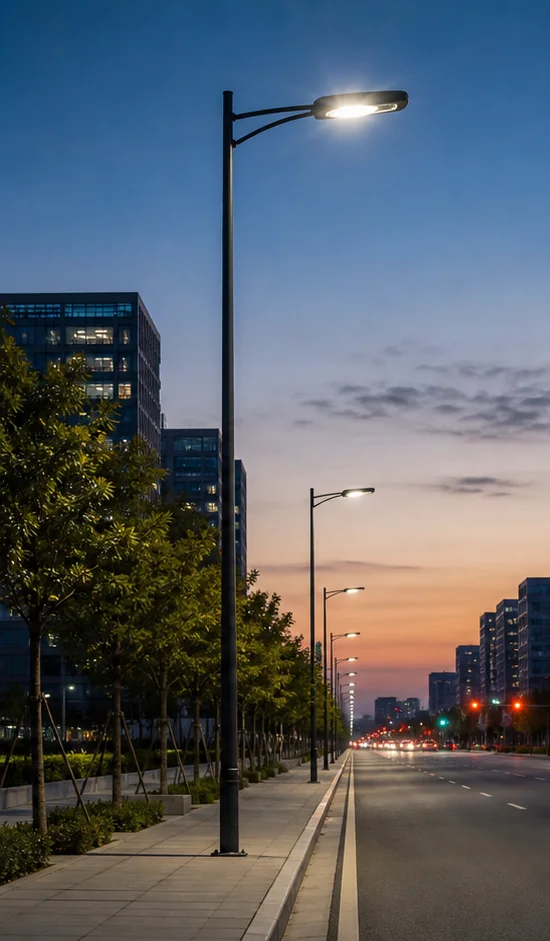
That number comes from the U.S. Department of Energy’s LED Adoption Report. It is useful because it has a named year, geography and methodology. It is not a claim that 51.4% of outdoor lighting in every country is LED today. Keep that distinction visible when you compare suppliers or applications.
| Verifiable number | Scope | What a buyer can learn |
|---|---|---|
| 51.4% | U.S. outdoor-lighting LED penetration in 2018 | Outdoor categories had strong LED uptake in the reported market |
| 40% | Share of 2018 LED energy savings attributed to outdoor applications | Outdoor lighting mattered materially in the cited U.S. energy result |
| 136 lm/W | FEMP threshold for pole/arm roadway and area luminaires | Efficiency targets should be model and application specific |
| 118 lm/W | FEMP threshold for floodlight luminaires | Floodlight benchmarks differ from roadway benchmarks |
| 126 lm/W | FEMP threshold for outdoor wall-mounted luminaires | “Outdoor LED” is too broad for one performance claim |
Why do source date and scope matter?
A data point without a source, country and date cannot be checked or applied responsibly.
The DOE report says its 51.4% figure refers to 2018 U.S. general-lighting installations. It also says outdoor applications contributed 40% of the total energy savings from LED lighting in that analysis. A reader can open the source, see the scope and decide whether the number is relevant to a project.
Which performance numbers are more useful than a generic market-size figure?
For a buyer, luminaire efficacy, photometry, lifetime, ingress protection and control behaviour often matter more than a global revenue estimate.
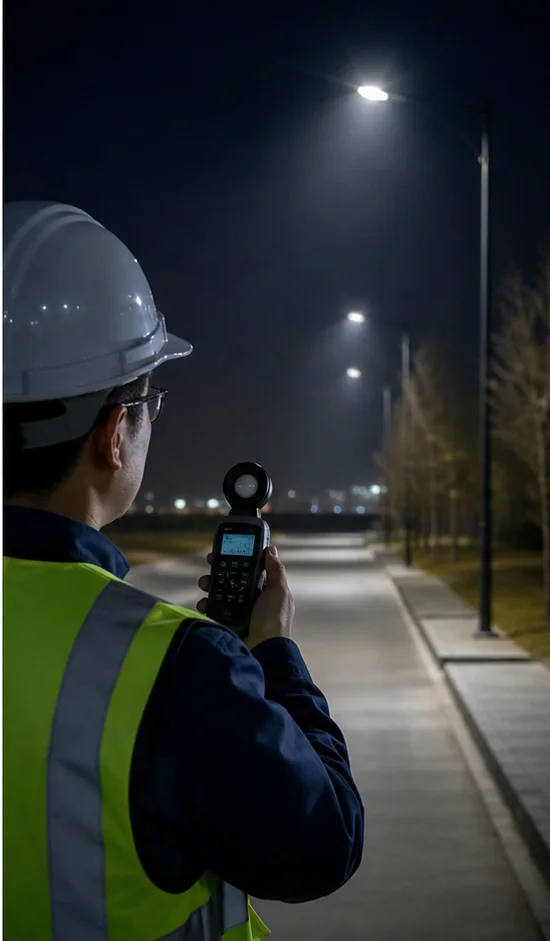
FEMP’s exterior-lighting guidance gives different efficiency thresholds by application: 136 lm/W for outdoor pole/arm roadway and area luminaires, 118 lm/W for floodlights and 126 lm/W for outdoor wall-mounted luminaires. Those figures do not choose the right product by themselves. They show why a page must name the product type before claiming efficiency.
For a tender or sourcing brief, add the mounting height, road or area geometry, target illumination, beam distribution, CCT, IP/IK need, driver and control mode. A 136 lm/W number is not proof that a fixture creates the right light on the ground.
How should buyers read a market-data table?
Put the number, unit, geography, date, source and practical meaning in the same table.
Avoid phrases like “the market will explode” or “the industry is worth billions” unless you can show the source report, methodology and date. If a commercial market report is behind a paywall, state that fact instead of copying a search-result snippet. If you use supplier data, label it as supplier-reported rather than independent market research.
What related information helps a buyer act on the data?
Link every number to the next decision a buyer needs to make: product choice, photometry, documentation or project enquiry.
Useful next steps include outdoor LED product families, a photometry and mounting guide, model-specific test files, a roadway retrofit case study and a project brief form. Those pages should link back here using the same terms a buyer searched: “outdoor-lighting efficiency,” “floodlight efficacy” or “roadway luminaire requirements.”
How should a supplier collect its own data?
Collect product, test, project and service data in separate fields so every claim can be traced to its evidence.
For a product, store model code, wattage, input voltage, lumen output, efficacy, CCT, beam distribution, IP/IK rating, driver, surge protection and test file. For a completed project, store application, country, mounting height, quantity, date, product model, before/after scope and customer permission to publish. For a service claim, store the warranty document and actual scope, not a decorative “5-year warranty” badge.
This creates useful article material without inventing a global market number. A lighting manufacturer can publish a table such as “four project applications, six fixture families and the model-level test files buyers asked for,” provided each entry is real and permitted for publication. It is more trustworthy than a generic CAGR copied from an unknown source.
Which source details make market data more useful?
A good source note lets the reader open the original report and understand the limit of the claim in under one minute.
Use this pattern: “Source: U.S. DOE LED Adoption Report, 2020 edition; metric: 2018 U.S. installed-lighting analysis; accessed 15 July 2026.” A reader knows the source, report date, measured year, geography and access date. Do not hide that information in an image or a vague footnote.
For a connected content cluster, publish a lighting data methodology page, a photometry glossary, test-report examples and application product pages. Link them in both directions, so the data article helps the reader choose a product and the product page helps the reader verify a claim.
How often should a data article be refreshed?
Refresh source-led data whenever the source updates or when a figure becomes older than its stated decision use.
Keep a visible update date and a short change log. If the only available market number is old or cannot be checked, do not decorate it with a current-year headline. Explain the limitation and focus the article on stable, useful buying data instead.
What should the reader take away?
A source-led lighting data page should help a buyer form a better brief, not merely repeat a big market number.
The most useful next step is to compare the exact application, performance target and evidence pack. That is what turns a statistic into a sourcing decision.
It is also the kind of data that a buyer can take into a supplier conversation immediately.
FAQ
Can I quote the 51.4% LED penetration figure as a global number?
No. It is a U.S. 2018 reference point in a named DOE report. Keep the geography and date beside it.
Is 136 lm/W the right target for every outdoor light?
No. The threshold cited applies to a specific exterior-lighting category. Match the target to the application.
Why is a source link important for GEO or AI search?
A named source makes the claim easier to verify, quote and trust. It also lets a reader inspect the original scope.
Should I publish a market-size number from a competitor’s blog?
No. Find the source report or leave the number out. A precise but unsupported number can damage trust more than it helps traffic.
Start a supplier conversation
Send a short project brief before asking for a final quote.
Include your target market, required specification, quantity and decision timing. It gives every supplier the same facts to answer.
Request a quote
Need supplier quotes you can compare?
Share your target market, quantity and key requirements. A clear brief makes it easier to compare the replies you receive.
Reading: Outdoor Lighting

Written by
Hannah Cole
Hannah turns lighting market signals, product data and application requirements into sourceable buying routes.
Reviewed and updated 2026-07-16
Keep researching
Related buyer guides
Outdoor Lighting
10 Outdoor Lighting Manufacturers in China to Research for Your 2026 Shortlist
Start with a shortlist of suppliers whose public product range matches your project, then verify the details that a catalogue cannot prove.
Read guide →