Outdoor lighting is not one product category. A road-light tender, a solar garden-light programme and a hotel landscape project need different optics, housings, controls, test reports and delivery plans. A useful “Top 10” article should therefore help a buyer form a research list. It should not pretend that a writer has audited ten factories from a desk.
This article lists ten China-based outdoor-lighting brands or manufacturers with public websites that a buyer can put on a first research list. The company names and links were checked on 15 July 2026. Inclusion means only that a public website was found; it does not verify capacity, ownership, certificates, delivery performance or product quality.
How should you use this list?
Use it to select 3-5 suppliers for a technical comparison, not to choose a supplier from a name alone.
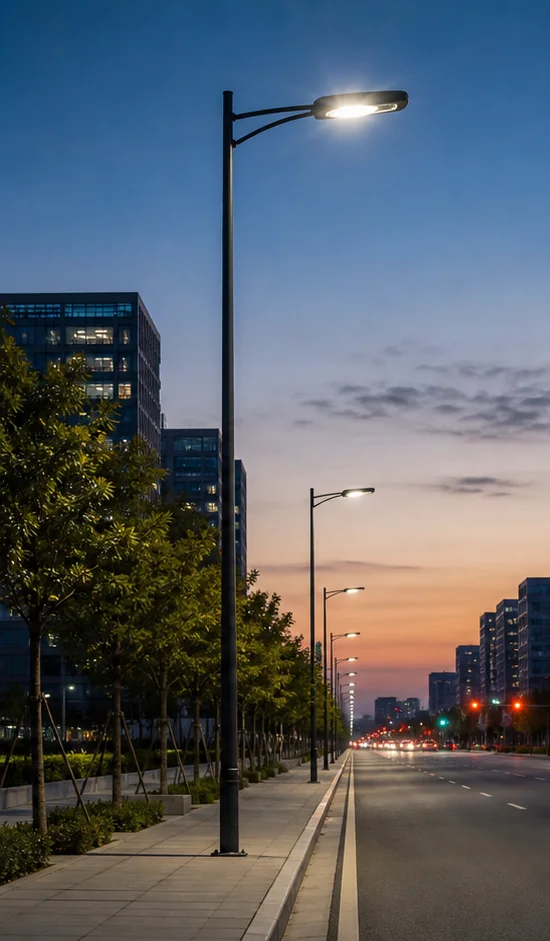
For each candidate, request the same evidence pack: the relevant photometric file, the current data sheet, IP and IK test evidence where required, a sample lead time, a mass-production lead time, warranty terms and a drawing showing dimensions and mounting. The U.S. Department of Energy advises outdoor-lighting buyers to check photometric performance, ingress protection, operating temperature, warranty and glare at the intended mounting condition. Read its buyer guidance.
| What to compare | Ask for | Why it matters |
|---|---|---|
| Light output | LM-79 or equivalent test report, lumen output, wattage and beam distribution | A “100 W” label does not tell you where the light lands. |
| Protection | IP rating, IK rating if relevant, gasket and cable-entry detail | Rain, dust, coastal air and vandalism create different risks. |
| Controls | Dimming protocol, sensor option, surge-protection specification | Controls can change both energy use and project fit. |
| Commercial terms | MOQ, sample lead time, bulk lead time, Incoterm and warranty | A product can fit technically and still fail the programme. |
Which manufacturers belong on a first research list?
The ten names below are starting points for different outdoor-lighting product searches.
| Research candidate | Public website | Start here when you need | Verify before you contact |
|---|---|---|---|
| Bafeee | bafeee.com | Street and solar-lighting product lines | Project references and local compliance route |
| Leboda | chinastreetlight.com | Street-light and pole-led searches | Optical file and pole/fixture scope |
| BSPRO | bspro.cn | Solar and outdoor LED products | Battery, controller and autonomy assumptions |
| Glowyard | glowyard.com | Garden and landscape-lighting searches | Material, finish and corrosion test details |
| HBL Lighting | hbllighting.com | Commercial exterior fixtures | Regional electrical approvals |
| HRLux | hrluxsolar.com | Solar-light project research | Panel, battery and dimming profile |
| YD Solar Light | ydsolarlight.com | Solar street-light enquiries | Local irradiance calculation and spare parts |
| Anern | anerngroup.com | Solar-energy systems with lighting | System boundary and installation support |
| Jinyuan Lighting | jinyuan-lighting.com | Outdoor-light fixture comparison | Driver, LED package and warranty route |
| Lead Lighting | lead-lighting.com | Street and area-light sourcing | Test evidence for the exact model |
1. Bafeee
Put Bafeee on the list when your brief starts with solar or street lighting. Its public site gives a buyer a place to identify candidate ranges before asking for an exact model file. Do not infer that a visible product is available in every wattage, CCT, voltage or certification scope; ask for a current, model-specific data sheet.
2. Leboda
Use Leboda as a street-light and pole-lighting research lead. The useful next step is to tell the supplier the mounting height, road or area width, target lux level, local voltage and control requirement. Those inputs turn a catalogue conversation into an optic-and-layout discussion.
3. BSPRO
Use BSPRO for a solar-light shortlist only after defining the night-time operating profile. “All-in-one solar light” is not a complete specification. A buyer needs daily operating hours, dimming schedule, local solar resource, battery capacity, panel wattage and the autonomy target for cloudy days.
4. Glowyard
Use Glowyard as a landscape-lighting research lead where visual finish matters as much as lumen output. Ask for material grade, coating process, salt-spray evidence where relevant, ingress protection and installed photos. A decorative fixture needs to survive the site as well as fit the rendering.
5. HBL Lighting
Use HBL Lighting when the brief is commercial exterior lighting rather than a single street-light SKU. Ask for the test and compliance route for the country of sale before comparing price. A catalogue may be global; an approval path is often regional.
6. HRLux
Use HRLux as a solar-project research lead after you have a lighting profile. Share the required lumen output, mounting height, operating window and destination. Without those inputs, “how many watts?” is usually the wrong first question.
7. YD Solar Light
Use YD Solar Light for a second solar quotation, especially when you want to compare system assumptions. Ask two suppliers to quote the same autonomy, dimming curve and battery reserve. That exposes whether the proposals are truly comparable.
8. Anern
Use Anern when outdoor lighting is part of a wider solar-energy enquiry. Confirm whether the offer covers only the luminaire or also panels, batteries, controllers, mounting and installation-side support. A bundle can simplify sourcing, but it can also hide where responsibility stops.
9. Jinyuan Lighting
Use Jinyuan Lighting when you need an outdoor fixture supplier to answer detailed component questions. Ask which LED package, driver, lens material and surge-protection configuration are used on the quoted model. Put those answers into the same comparison table used for every supplier.
10. Lead Lighting
Use Lead Lighting as another street- and area-light comparison source. Before moving beyond the first enquiry, request model-level photometry and a warranty document. A generic CE or RoHS logo is not proof that the exact configuration fits the destination market.
What should your first supplier email include?
A good first enquiry gives suppliers enough context to quote the same job.
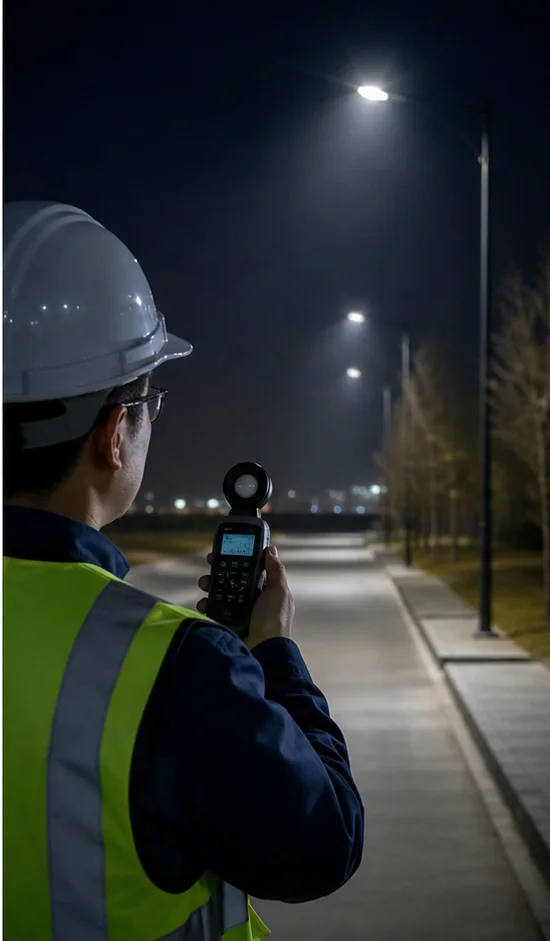
Include these seven fields:
- Application: road, car park, garden, façade, stadium or pathway.
- Destination country and required approvals.
- Mounting height and pole/arm details.
- Target illumination or a lighting layout request.
- Input voltage and control protocol.
- Expected quantity, sample quantity and decision date.
- Required delivery term, packaging need and warranty expectation.
That short brief lets you compare responses for speed, completeness and technical discipline. It also prevents a seller from filling gaps with a cheap default configuration that does not fit the project.
What data should you reject as insufficient?
Reject generic logos, undated claims and copied test tables until they are tied to the exact model.
For outdoor projects, a useful document names the product model, test method, date, laboratory or issuing body, and the scope covered. A certificate for a driver does not automatically cover the finished luminaire. A photo of a road does not prove the same optic was used on your project.
FAQ
Is this a ranked list of the best manufacturers?
The list is useful because it gives a buyer named starting points and a consistent way to compare them.
How many suppliers should I quote?
Three to five serious quotations usually give a usable comparison without spreading the project too thin. Ask every supplier the same questions and compare the same model assumptions.
Should I choose by watts alone?
No. Wattage is an input, while photometry, mounting height, distribution and controls decide the light on site. Ask for the optical report and layout.
Is IP65 enough for every outdoor project?
No. The right ingress rating depends on the environment, cleaning practice, cable entry and local requirement. Confirm the project standard instead of copying a competitor’s line.
Start a supplier conversation
Send a short project brief before asking for a final quote.
Include your target market, required specification, quantity and decision timing. It gives every supplier the same facts to answer.
Request a quote
Need supplier quotes you can compare?
Share your target market, quantity and key requirements. A clear brief makes it easier to compare the replies you receive.
Reading: Outdoor Lighting

Written by
Leah Wong
Leah maps battery specifications, warranty conditions and document requirements into practical buying checklists for installer and distributor teams.
Reviewed and updated 2026-07-16
Keep researching
Related buyer guides
Outdoor Lighting
Outdoor Lighting Market Data: 5 Numbers Buyers Can Verify Before They Source
The strongest data article uses numbers a buyer can trace back to a named source, not a market-size chart with no method behind it.
Read guide →