Globe valves use a movable plug or disc and a stationary seat. As the stem moves, the plug changes the opening through which the fluid passes. This makes the design useful for regulating flow, but the internal change of direction usually creates more pressure drop than a straight-through isolation valve.
How does a globe valve work?
Turning or actuating the stem moves a plug toward or away from a seat, changing the flow opening.
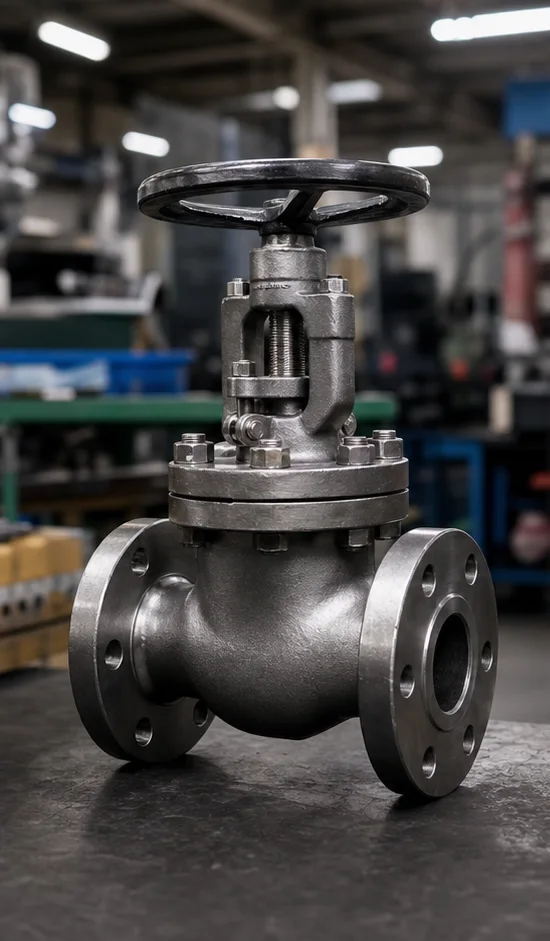
In a manual valve, a handwheel drives the stem. In an automated control valve, a pneumatic, electric or hydraulic actuator moves the stem. The important point is not the outside shape; it is the controllable relationship between travel and flow. Spirax Sarco notes that globe valves are widely used for control work because they suit throttling and can be given a defined flow characteristic. Read its control-valve guide.
| Main part | What it does | Buyer question |
|---|---|---|
| Body | Contains the pressure boundary and flow path | Which material and pressure class match the medium? |
| Seat | Provides the sealing surface | Is the seat material compatible with temperature and fluid? |
| Plug or disc | Changes the opening and control behaviour | What trim characteristic is supplied? |
| Stem | Transfers motion from handwheel or actuator | What packing and stem material are used? |
| Bonnet | Holds the stem and packing arrangement | Is the maintenance route suitable for the installation? |
When is a globe valve the right choice?
Choose a globe valve when you need repeatable throttling or control, not merely open-or-closed isolation.
It is common in steam, water, process-fluid and utility systems where a controller or operator needs to adjust flow. The trade-off is pressure loss. If the job is only to isolate a line fully open or fully closed, a gate, ball or butterfly valve may be a more suitable starting point. Selection belongs to the process engineer and the applicable code, not to a generic product title.
Which globe-valve pattern should you compare?
Compare the flow pattern before comparing price because the body pattern changes pressure drop, piping layout and service fit.
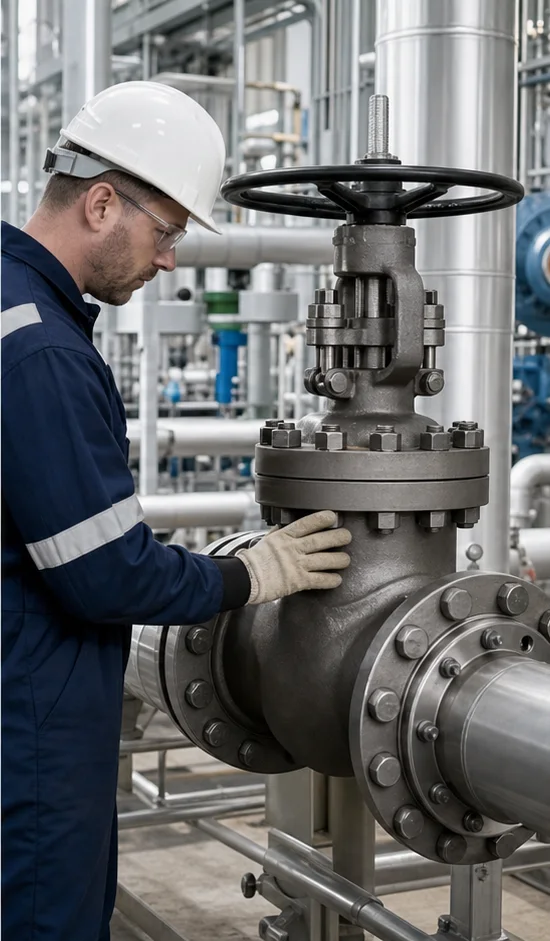
| Pattern | Basic flow path | Typical reason to consider it |
|---|---|---|
| T-pattern | Flow changes direction through the body | A common choice where control is the main job |
| Y-pattern | A more angled flow path | Used where lower pressure drop is important |
| Angle pattern | Inlet and outlet meet at roughly 90 degrees | Can simplify a pipe turn and reduce fittings |
| Three-way | Mixes or diverts flow | Used where two streams or directions must be managed |
What data should appear on a useful globe-valve product page?
A buyer needs model-level pressure, temperature, material, connection and trim information before asking for a quote.
At minimum, show nominal size, pressure rating, body and trim materials, end connection, flow direction, temperature limit, actuator option, Cv or Kv where relevant, test standard and applicable certificates. Do not write “high quality industrial valve” and hide the facts in a PDF. Place the specification table close to the enquiry CTA, then link the technical terms to useful pages.
For example, a product page can link a body-material field to valve material selection, its pressure class to pressure-test evidence, its connection type to flange and thread options and its certificate tag to model-specific certificates. Each of those pages should return a reader to the product range.
How should you select a globe valve for a project?
Start with the fluid, pressure, temperature and control requirement before you ask for a model number.
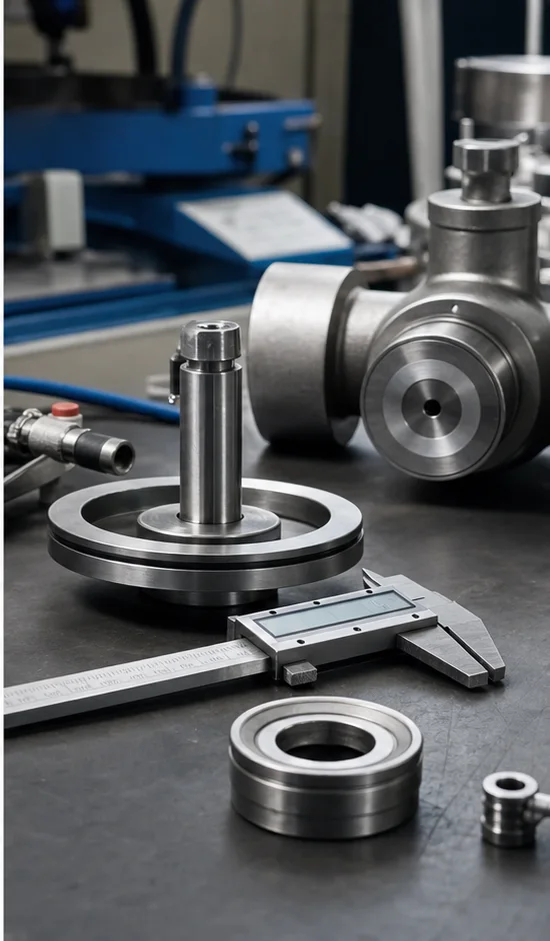
Send a supplier a short data sheet: medium, normal and maximum flow, inlet and outlet pressure, temperature range, line size, available differential pressure, required control signal, installation position and destination standard. If the valve will be automated, state fail position and actuator air or power supply. This is the difference between a technical selection and a catalogue guess.
What should a supplier test and document?
Show the inspection and test evidence that matches the quoted valve, pressure class and end connection.
The exact test plan depends on the applicable standard and service. A useful supplier conversation distinguishes material inspection, body pressure testing, seat leakage testing, dimensional checks, actuator operation and final identification marking. Ask which tests are routine for every unit and which need to be witnessed or supplied as a report. A strong answer names the standard, acceptance criterion, record format and responsibility for review.
Do not accept a photo of a gauge as a pressure-test certificate. A document should identify the valve model, size, pressure class, serial or batch reference, date, test medium, result and approving person. When a valve is configured with special trim or an actuator, make sure the report covers the delivered configuration rather than a stock body.
A practical decision path is: globe-valve product pages → pressure-test process → material traceability → project enquiry. The test pages should then link back to the model pages that use the same components and standards.
What is the common mistake in a globe-valve quote?
The common mistake is treating “globe valve” as a complete specification when it is only the starting valve type.
Two valves can share that name and differ in body material, seat construction, trim, pressure rating, connection, actuator, flow direction and documentation. Put each of those fields into the quote request. That helps the buyer compare technical fit before negotiating price.
When should you involve a valve engineer?
Involve a qualified valve or process engineer whenever safety, hazardous media, high pressure, high temperature or critical control is involved.
An online guide can explain terminology, but it cannot confirm a valve for a real process. The engineering review should use the actual design data, applicable code, fluid properties and installation context.
That boundary is a mark of reliable technical content, not a weakness.
It also prevents a reader from applying a generic answer to a process that needs formal design review.
FAQ
Is a globe valve the same as a ball valve?
No. A globe valve normally uses linear motion and a seat-and-plug arrangement, while a ball valve uses a rotating ball. Their control behaviour and pressure drop differ.
Does every globe valve control flow accurately?
No. Control quality depends on trim, sizing, actuator, positioner and process conditions. Specify the control objective rather than assuming the valve name is enough.
Why does pressure drop matter?
Pressure drop affects energy use, process capacity and the valve’s ability to control flow. Ask the engineer or supplier to size the valve from the real process data.
Can I use a manual globe valve in an automated system?
Sometimes the same valve family accepts an actuator, but the exact body, stem and mounting must be confirmed. Do not assume retrofit compatibility.
Start a supplier conversation
Send a short project brief before asking for a final quote.
Include your target market, required specification, quantity and decision timing. It gives every supplier the same facts to answer.
Request a quote
Need supplier quotes you can compare?
Share your target market, quantity and key requirements. A clear brief makes it easier to compare the replies you receive.
Reading: Industrial Components

Written by
Aaron Li
Aaron researches industrial components, documentation routes and the questions buyers should settle before a technical quotation.
Reviewed and updated 2026-07-16
Keep researching
Related buyer guides
Industrial Equipment
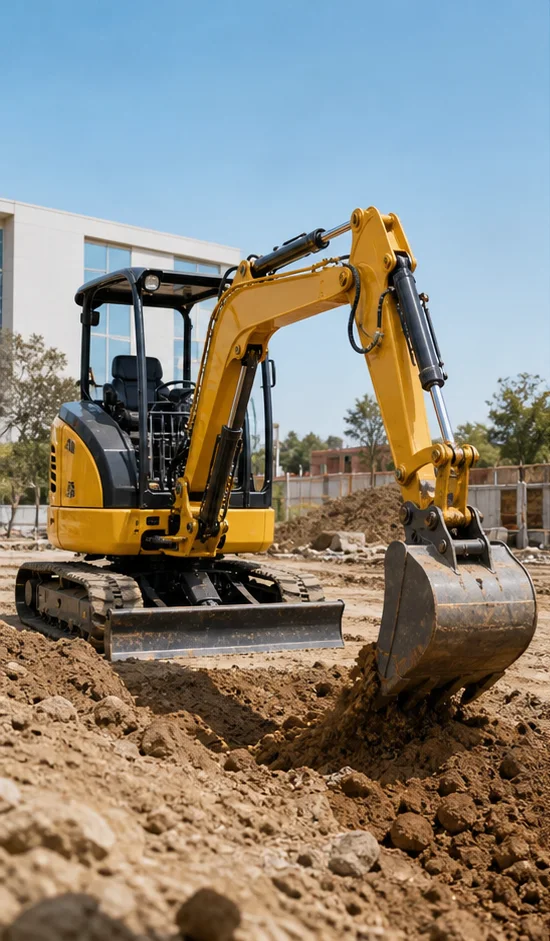
Mini Excavator Price: What a China Quote Actually Includes in 2026
A mini excavator listing price is useful for a first budget, but it does not tell you the final landed or project-ready cost.
Read guide →